So, it's been weird. Mostly due to weather. *sigh* I finally got fiber optic installed for my internet, and that is a big plus. However, I failed to inform my cats of this ahead of time and they are finally coming out of "the trauma" that happened on Wednesday, lol. Poor little furballs.
The weather has gotten very cold but the worst of it seems to have avoided it. I am in hibernation mode until maybe Tuesday.
Not much else to say. Just letting people know I am still around even if I'm not posting often. Take care everyone, and stay safe!
Happy Birthday, cairistiona! I enjoy your posts so much. Of course Boom and Pip are bringing you breakfast in bed, and will snuggle close in these cold temperatures. ♥
I think the last time I went to the deep cut rail trail in Westmoreland was two years ago. Back then a huge slab of stone had slid off the bedrock in the southern canyon and had plugged up one of the drainage channels. That had caused a lot of flooding, and a lot of the trail had washed away or was underwater. But that was two years ago and the damage has been repaired so on this day, just toward the end of the January thaw in the last post, I found myself walking through the northern canyon, which is the deepest of the two. From here we walk south.
What first drew me to this place years ago was the ice that grows here. I had never seen anything like it. It was like walking into a painting by someone like Van Gogh, who saw nature in a way that no one ever had before.
Not only is there a lot of ice, it comes in colors like this tan / pink / orange/ brown ice seen here. The colors listed come from my color finding software, not from these eyes.
Though I have no scientific proof I’ve always believed that the colors of the ice must come from the various minerals in the groundwater. You can see staining on the rock face in this shot, and you can also see how the groundwater seeps through the cracks in the stone. There is a lot going on here.
In places water pours through the stone, falling into the drainage channel below just as the railroad engineers designed it over 150 years ago. As I stood watching all I could hear was splashing water and birdsong.
The Tao Te Ching says “Nothing is as soft and yielding as water, yet for dissolving the hard and inflexible nothing can surpass it.” And this is where that verse comes alive for anyone who wants to pay attention. Here we can see by the white ice behind and set back from this stone face that water has gotten in behind the stone. This stone has cracked into large pieces and when water freezes in the cracks the expanding ice can exert enough pressure to crack the stone even more. We can see some of the fallen stones there in the foreground, and more will surely fall. There are lots of reasons to stay in the middle of the trail in this place, and to stay aware and alert.
Changes, especially geologic changes, can be subtle and almost imperceptible. If you are to see many of the changes taking place in nature you have walk the same trail again and again, and that’s why I’ve been coming here since 2013. This place gave me a much clearer picture of how groundwater moves through the earth and how the constant pull of gravity works on all things. I’ve seen a lot of falling ice, falling stone, falling trees and moving water here in that time.
And I’ve seen a lot of rock and ice climbers. I’ve added this photo from a few years ago to give you a sense of scale. Folks from the New Hampshire branch of the Appalachian Mountain Club come here to train in rock and ice climbing and this shot shows how they do what they do. I saw signs that they had been here this year but there was nobody here on this day. They’ve told me that the canyon’s deepest point is about fifty feet but it varies quite a lot over its length. Clearly the railroad removed a lot of stone from here. Shave down the high spots and use the resultant stone and gravel to fill in the low spots and eventually you’ll have a level rail bed.
It is in places like this where we can learn how to tell “good ice” from “bad ice.” Good ice is nice and shiny, transparent and very hard. If you rap on it with a piece of hardwood branch it rings and resists. It can be colored, often blue due to its denseness, but it is always shiny with a fresh appearance.
Bad ice is rotten ice. Ice becomes rotten when water, air bubbles, and/or dirt get in between the grains of ice and cause it to honeycomb and lose its strength. Instead of a sharp ringing crack when it is struck it produces more of a dull thud. The grayish white color and matte finish are a sure sign that you should stay away from it, especially when it’s hanging over your head. Ice grows very clear and shiny when it’s cold and it doesn’t usually get rotten until March but here it was in Mid January and there was lots of it.
With all this water and all this cold it shouldn’t surprise anyone to find themselves walking on ice in this place. The best way to deal with it that I’ve found, is to wear spikes. I use Kahtoola micro spikes like those seen here. I once slid down an icy hillside trail with Yaktrax on but when wearing micro spikes that doesn’t happen. Once again I thank Paula, the reader who first told me about them. They’ve shown their worth many times.
Just as I got to the well built stone walls that signal the start of the southern canyon I saw that a large old maple had fallen across the trail. This happens frequently here and it makes me wonder what they did when the trains were running. Did they carry a crew with tools on trains? They would have had to do something quickly because a train never would have made it under this tree and they ran through here at least twice each day.
On this day the ice I found in the southern canyon was nothing like I remembered. A few years ago ice covered the walls so completely it was hard to tell they were made of stone. Now the big ice columns were apart, here and there. It’s hard to describe their size but if you think of tree trunks, a 100 year old white pine maybe, you won’t be far off the mark. This was as far into the southern canyon I went on this day because I could see these columns were rotten. Sun shines on the stone and warms it, and this melts the ice at the rear of the column. This frees it from its hold on the wall and eventually with no support, gravity takes over and they start to fall. Since the southern canyon receives the most sunlight it becomes the most dangerous in spring.
The danger of falling ice in this canyon lies in the fact that these ice columns are so tall they can fall across the trail, as this shot from a few years ago shows. Any one of those ice blocks would have easily crushed someone, so I stay away when I see rotten ice here.
I used to wonder what would happen if this huge slab of ice ever let go, and then I found out when it did. More accurately the slab of of stone under the ice broke away from the hillside and slid into the drainage channel, damming it up. The water had nowhere to go so it ran into the trail, finally washing it away. The southern canyon became impassable unless you had waders on.
This I think was the last photo I took here, two years ago. You can see what a mess the southern canyon became. You can also see pieces of the stone slab, about 18 inches thick on the right in the background. How they ever broke it into pieces, I don’t know.
On this day I could see how things had changed, There was a new gravel bed over the entire length of trail that I walked and there had been improvements made in drainage. Keeping water flowing is the most important thing here. What I couldn’t see of course was if all the wildflowers will grow back after all the digging and soil compaction that went on. I’ll be here in the spring to check. In spring and summer the southern canyon is filled with all kinds of wildflowers, or it used to be.
Losing access to the southern canyon meant losing access to the great scented liverworts like those seen in this shot, and the other unusual mosses and liverworts that grow here. This is a truly beautiful thing and I’ve missed being able to see it.
On this day I did go far enough into the southern canyon to see the green algae called Trentepohlia aurea. Though it is considered “green” algae the same pigment that colors carrots orange makes green algae orange. After two years it was nice to see it again.
These algae are very hairy. They produce spores which, when produced in high enough concentrations, can even color rain. I once read about a blood red rain that fell in parts of Spain in 2014. Many worried that it was a bad omen or extraterrestrial in origin, or a plague worthy of the Bible, but it was actually caused by the algae Haematococcus pluvialis. The same thing happened in Texas in 2013, in Sri Lanka in 2012, and in India in 2001, each seemingly caused by different algae. Yellow, green, and black rain has also been reported. It seems that colored rain can happen just about anywhere on earth when conditions are right.
Since it was too dim in the canyons to use my regular camera I was forced to use my cellphone for most of these photos. That’s why some of them have a kind of garish, overdone look to them, like this evergreen fern on ice.
I saw a stone that looked very out of place on my way out of the canyons. It took me a while to realize it seemed out of place because it was natural. It hadn’t been reworked by the railroad like all the other stones. How did it get here, I wondered. A fern had draped itself over it for warmth.
There was something very strange about this low wall. Do you see it?
It was the odd stone capping this section of wall. I’ve built a lot of stone walls but I’ve never seen anything like the sculpted look of this stone. I can’t even guess where the railroad stone masons might have found it or what geologic event might have caused it. It looked almost as if it had come from the sea bed.
This was probably the most disturbing thing I saw here. An almost barren hillside in January. In a “normal” winter there would be many feet of snow in these canyons. “Oh the times they are a changin’” Bob Dylan sang. Believe your own eyes, not the lies.
I had entered the rail trail north of where I usually do because there was a snowless place to park and a low stone wall that I could sit on to put on my micro spikes. In this place there is a railroad built water channel that runs under the rail trail and into a chamber or cistern, and from there the water travels under Route 12 North and out the other side where it continues off into the woods. It’s quite a feat of engineering when you consider it was done a hundred and fifty years ago.
The cistern is covered by large slabs of granite and isn’t much to look at, but there is always the sound of running water echoing out from it.
I had missed this permit from the New Hampshire Department of Environmental Services on the way in. It gives permission to repair and improve this section of trail. Most interesting is who was asking for permission; a snowmobile club called the Sno Riders of Keene. I’ve been saying for years now that instead of complaining about snowmobiles on “our” trails we should thank them and donate to them if possible, because they are the people who donate much time and effort in keeping these trails open for the rest of us. Without them there might not be any trails to enjoy, so step to the side and give them a thank you wave as they ride by.
And then there was this. Winter returned and the thaw was officially over. It was back indoors for many and for some that will mean loneliness. I remember when I was a boy the older folks speaking of the loneliness of winter but many of them had been around before radio, television, and even electric lights. My Grandmother was born in 1899 and she could tell stories that made you feel lonely just by listening to them. But staying inside is a good idea right now. This has been a cold winter so far and right now is when we’re supposed to see the coldest stretch, with below zero wind chills. They’re saying -15 to -25 degree F. wind chill temps in parts of the state, which is dangerously cold. Be smart and stay safe. They say we might also see 18 inches of snow, so why not check on your elderly neighbors who live alone if you can? That was something I was taught when I was growing up and it was something we all did. It’s a good habit to get into because our time will come and when it does we may find ourselves elderly and alone.
I am no more lonely than a single mullein or dandelion in a pasture, or a bean leaf, or sorrel, or a horse-fly, or a bumblebee. I am no more lonely than the Mill Brook, or a weathercock, or the north star, or the south wind, or an April shower, or a January thaw, or the first spider in a new house. ~ Henry David Thoreau.
And please do check out the comments for all the awesome participants of the challenge and visit their journals/challenge responses to comment on their posts and cheer them on.
And just as a reminder: this is a low pressure, fun challenge. If you aren't comfortable doing a particular challenge, then don't. We aren't keeping track of who does what.
I don't think I posted about Amperslash when it revealed, but I got a lovely gift!
The Ties that Bind Us (Biggles, slightly ambiguous Biggles/EvS) A very fun, sensual fic in which they are trying to squirm out of ropes tying them together, while also talking about Feelings.
And I got THREE gifts in Holiday Airdrop, the Biggles exchange I run! This time around, all are gen and Algy & EvS-focused.
Soft Landings, a wonderfully well realized, hurt/comforty AU in which Algy is the first person on the team to encounter Erich during Buries a Hatchet.
A Silver-Topped Cane is a lovely little post-Terai bit of comfort and bonding, in which Erich offers advice and maybe a little commiseration while Algy is healing.
Forge is deliciously iddy and visceral h/c in which EvS and Algy are handcuffed together in the desert.
Between the two exchanges, I wrote five fics, including some pairings I don't normally write! I'm looking forward to getting to 'fess up to them.
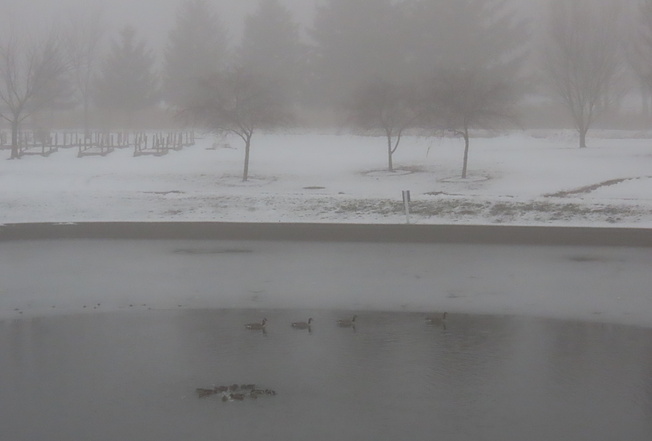
A couple of photos from a foggy morning, with some geese serenely sailing by. You can better see the scrum of ducks in the next photo, gathered around the aerator. We can only assume that it's the best place to get algae from, maybe it pulls it to the surface?
And just as a reminder: this is a low pressure, fun challenge. If you aren't comfortable doing a particular challenge, then don't. We aren't keeping track of who does what.
^Same userpic as last week, because it's still cold! Clear and sunny, so not bad for walking, but, still. They are talking about a SIGNIFICANT SNOW EVENT for us this weekend. We shall see!
What I Just Finished Reading
Sing Like A Fish:How Sound Rules Life Underwater, by Amorina Kingdon. cairistiona, it was extremely readable and enjoyable! I learned so much. There is a fish, along the Pacific Coast, with mating calls! I can't even imagine. Less enjoyable, but still very worthwhile, was Birds at Rest: The Behavior and Ecology of Avian Sleep, by Roger F. Pasquier. (Academics should not be allowed to publish approachable, engaging prefaces to their books, if the books themselves are going to be pretty dry. That's deceptive!) *grin* But again, I learned a lot about avian behavior that had never occurred to me before. @cairistiona, an even more enjoyable book about fish is What A Fish Knows, by Jonathan Balcomb, which I remember I really liked.
On the fiction side, Malinalli, by Veronica Chapa, had inconsistent characterization and confusing plotting. For Dreamwidth Book Bingo: Author's Debut, as well as Goodreads Tale Spinners challenge (Fairy tale or mythology retelling).
An absolute impulse purchase (boy, have I been doing a lot of that lately) was What If...Loki Was Worthy?. An odd impulse because I haven't been into Marvel in ages and am several movies behind. (Sorry, Captain America Sam. Sorry, Bucky.) If this book had been fic, it would be Crack!fic, an absolutely wacky and enjoyable ride. My absolutely favorite Loki Redemption fic, though, is "Monsters", by coneycat, the opening of her "Housemates"series.
I have a list of library holds as long as my arm, which I plan to pick up tomorrow. Which is crazy, because it isn't like I don't have another virtual stack of ebooks on my iPad. I just like walking to the library, I guess.
Question of the Day:
Snow:Yay! or Snow
(That would be me. It's not that I mind snow, per se - it's pretty on the garden, so peaceful looking, and we certainly need the moisture. It's the danger and difficulty of walking the days after.)
And please do check out the comments for all the awesome participants of the challenge and visit their journals/challenge responses to comment on their posts and cheer them on.
And just as a reminder: this is a low pressure, fun challenge. If you aren't comfortable doing a particular challenge, then don't. We aren't keeping track of who does what.
Just thinking about the wonderful harmonies of the Mamas and the Papas this morning. I wish pop music hadn't abandoned talented singing and harmony for auto-tune. /curmudgeon comment of the day
It's cold, but well, it's also January, so to be expected. Still don't like it, but you do what you gotta do. I'm very impressed, however, with the whole-house humidifier. It's keeping the humidity at a stead 32-33%, which is just fine for comfort. I haven't broken out in itchy spots because of the dry air even once since hubby installed it.
We had to grocery shop yesterday in the 12F temps. That's such a pain, because you bundle up for the walk in from the car to the store, but then you start sweating by the time you're done in the store. They need to have coat check rooms at the front of stores.
Dink is always busy on Sundays, as she's found a church she likes, and they have a small group Bible study later in the day, but she's off today--Happy Martin Luther King Day (amazed Dump hasn't cancelled it), so she came out to raid our fridge and pantry yesterday evening. I don't cook on Sundays, so I just told her to have at it. We were, thanks to grocery shopping, at least well stocked.
She'll probably come over today for lunch or supper or both. She mooches food whenever she can. XD
Today is another cold one, with temps staying in the 20Fs all day. We *might* have a chance of snow at the end of the week, but I'm not getting excited just yet. We're in a severe drought right now, and when we're in the midst of them, it feels like it won't every rain or snow ever again.
So that one B5 script book that supposedly came via FedEx a week ago still hasn't turned up, but today I got an extra copy of one I already have that I was not expecting with an Amazon order number that isn't in my orders anywhere.
![[personal profile]](https://www.dreamwidth.org/img/silk/identity/user.png) shirebound
shirebound


![[syndicated profile]](https://www.dreamwidth.org/img/silk/identity/feed.png)


![[community profile]](https://www.dreamwidth.org/img/silk/identity/community.png)